Stupa at Pauenhof, decorated with Buddha eyes and prayer flags, a place for mindfulness and silence

A retreat is an invitation to step back, to pause, and to meet yourself in stillness. For a dedicated period of time, daily life moves into the background – creating space for mindfulness, meditation, and inner clarity to naturally arise.

We practice in noble silence. This shared silence creates a protected and powerful atmosphere in which you can arrive more deeply within yourself, free from outer distractions. On the final day, the silence is gently lifted together.

The daily schedule is clear, simple, and repetitive. This structure offers grounding and support. Practice begins with the first bell in the morning and accompanies you – in mindfulness, quiet presence, and awareness – throughout the day until you fall asleep.

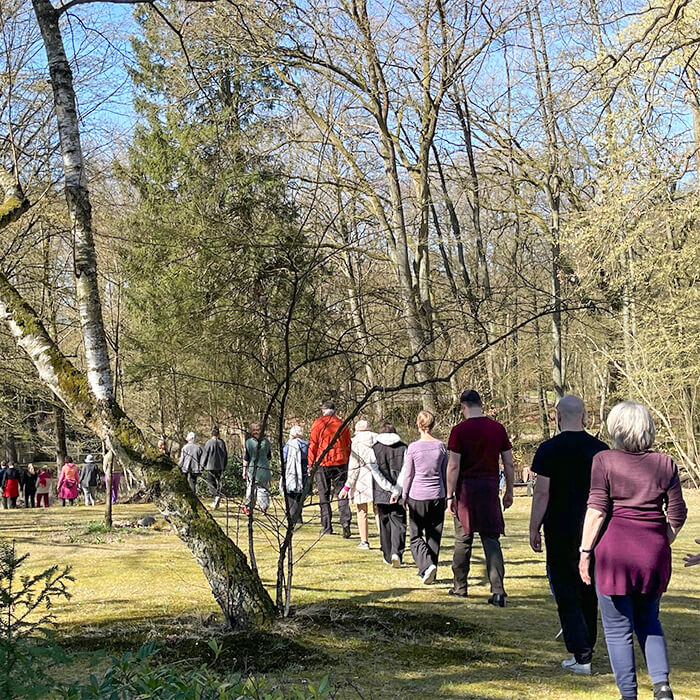
19 people practice mindful walking meditation in the park of the House of Silence during a trauma-sensitive silent retreat.
  • Meditation in Stillness and Movement Periods of sitting and walking meditation alternate throughout the day. All practices are gently and skillfully guided.
  • Embodied Mindfulness Soft yoga and embodiment practices support a deeper sense of felt presence, grounding you in the wisdom of your own body.
  • Dharma Teachings & Reflections The Buddha’s teachings are shared in a living, accessible way – connected to your inner experience and to the reality of everyday life.
  • Meditation in Action
    One hour of daily mindful service (for example in the garden or the house) invites awareness into simple, ordinary action. (This element depends on the retreat location.)
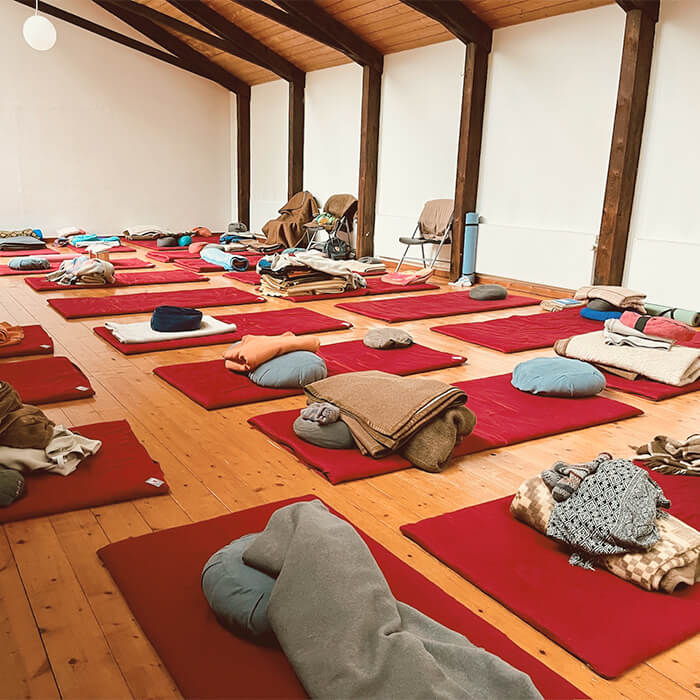
Meditation hall at the Deep Rest Silent Retreat with red mats and cushions for trauma-sensitive meditation while lying down.

Please bring comfortable clothing, warm socks, and indoor slippers. An extra blanket is very helpful, as we spend significant time meditating while lying down. It is recommended to refrain from reading during the retreat in order to stay connected with your present-moment experience. A notebook can be supportive.

All retreats are offered on a dana basis – meaning they are given in the spirit of generosity and supported through voluntary donations, as is customary in the Buddhist tradition. Please remember to bring a donation that feels appropriate and respectful, within your own means. The dana offering takes place at the end of the retreat.

Icon of a meditating woman with folded hands in the Namaste greeting

Can we truly put a fixed price on teachings that lead to freedom and peace?

What is the value of awakening to qualities like compassion, equanimity, ease, and joy?

For centuries, wisdom teachings have been shared freely – carried by trust, connection, and gratitude. In the Buddhist tradition, dana (Pali for “generosity” or “giving”) is considered the foundation of spiritual development.

Dana is more than an act of giving – it is a deeply transformative practice that expands the heart and loosens the collective trance of separateness.
It invites us to practice trust: that there is enough, that we do not lose when we share.

In the practice of dana, we begin to notice our inner attachments:
• the fear of not having enough
• the wish to stay in control
• the · belief that we must “earn” everything

When we give without expecting anything in return, we can experience moments of inner freedom. At the same time, Dana is a path. A practice of letting go and offering, which may at first feel tender or tight.

Dana helps soften the habitual orbit around ourselves.
It reminds us: we are not separate from one another. What we truly are is far more spacious than we imagine – and it grows when we share it.

Ten filigree painted stones, partly covered with gemstones, artfully and colorfully arranged, aesthetically pleasing.
Ganesha figure on a round silver tray with flowers, colorfully decorated stones, and lotus candle in the grass, meditative and mindful.
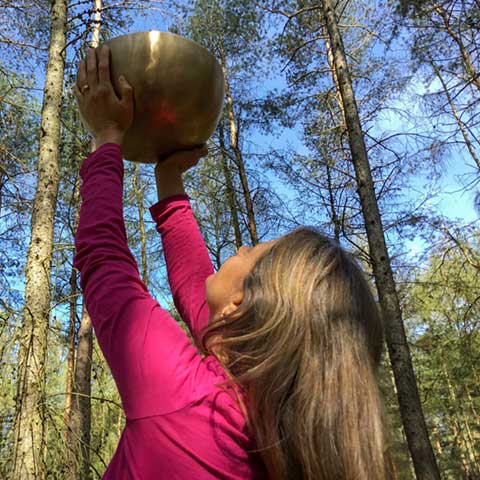
Nirmala from the side from behind in the forest, holding a large gilded singing bowl in the air, bright blue sky with branches in the foreground.

More than material support

Dana goes far beyond financial giving. Sharing, helping, listening, and offering presence are heart qualities nourished by this practice. Dana invites us to let go – not only of material possessions, but also of assumptions, opinions, and the deeply rooted sense of a fixed self. It opens the heart, widens our capacity, and strengthens our sense of connection.

When we feel joy in giving, we sense: I am part of something bigger. It makes a difference to me how you are doing. We are on this journey together.

"

If I keep everything for myself, what is left to give to others?

– Tibetan proverb –
And more concretely?

A large part of my offerings are held on a dana basis. Financial contributions are a form of appreciation that I deeply value. They allow me to offer yoga, mindfulness, and meditation in places where financial means might otherwise limit access – and they help us create this field beyond capitalist principles.

Every contribution, in any amount, is helpful and supports others as well.

Thank you from my heart for honoring both your resources and mine, and for your trust.

Bank transfer:
IBAN: DE57 2565 0106 0036 2990 55 | BIC: NOLADE21NIB

"

If you knew what I know about the power of giving, you would not let a single meal pass without taking the opportunity to give something.

– Tibetan proverb –
Soulteachings Icon | Meditating Woman

1. What is Buddhism, really?

Buddhism is not a rigid religion with a fixed belief system – it is more a path toward understanding life more deeply.

It is based on the experiences and teachings of Siddhartha Gautama, the Buddha, who lived over 2,500 years ago in what is now Nepal. His central question was: What causes suffering – and how can it be overcome?

Over the centuries, many different schools and traditions have developed. That’s why there isn’t one Buddhism, but many diverse streams with different emphases.

What unites them is the orientation toward inner freedom, compassion, and mindfulness – and the invitation to examine everything for yourself rather than believing anything blindly.

2. Who was the Buddha?

The Buddha was not a god, but a human being.
His name was Siddhartha Gautama, born in the 6th or 5th century BCE in what is now Nepal. He grew up in wealthy circumstances but left his family as a young man to seek answers to fundamental questions: Why do we suffer? Is there a path to inner peace?

After years of searching – in asceticism, meditation, and deep self-inquiry – he reached what in Buddhism is called “awakening”: a profound insight into the nature of mind, life, and suffering. From then on he was called “the Buddha” – the Awakened One.

What he taught were not dogmas, but an experiential path.
His teachings were written down only centuries after his death – and have been interpreted differently across many traditions. We cannot say with certainty what he said word for word. But the essence remains:
A life of mindfulness, compassion, and insight is possible – here and now.

3. What did the Buddha actually teach?

At the heart of the Buddha’s teaching is a simple yet profound insight:

There is suffering – and there is a way to relate to it wisely.

He called this existential discomfort dukkha – a word often translated as “suffering,” but it also includes dissatisfaction, inner tension, loss, or the subtle sense that something is “not quite right.”

Instead of giving theoretical answers, the Buddha offered a practice: a path to recognize what causes this suffering – and how we can learn to free ourselves from it. Not through avoidance or control, but through understanding, feeling, and letting go.

He emphasized again and again: You don’t have to believe anything See for yourself what is wholesome. This attitude is what keeps Buddhism alive and open to this day.

4. What does Dharma mean?

The Buddha used a word that existed long before him in spiritual and philosophical traditions: Dharma.

Dharma cannot be fully captured by a single English word. It means something like: “that which supports,” “that which gives orientation,” “that which is true and helpful.”

In the Buddhist context, Dharma refers on the one hand to the Buddha’s teaching – what he said about suffering, compassion, mind, and liberation. But the term goes beyond that.

Dharma also refers to a kind of deep, healthy common sense – a way of seeing the world grounded in experience, interconnection, and inner clarity. It points to what feels wholesome, sustainable, and aligned with the natural rhythms of life.

Change, impermanence, interconnectedness – all of this is part of the Dharma.

Dharma is not abstract. It is something we can experience here and now: in the body, in the breath, in every mindful action – right in the midst of life.

5. The Four Noble Truths

The Four Noble Truths form the core of Buddhist teaching. In them, the Buddha summarizes his fundamental insights into human life – and describes a path for relating wisely to inner suffering and dissatisfaction.

These truths are not dogmas but invitations to inquiry. They describe what many of us sense in life anyway – often without having words for it.

1st Noble Truth: There is dukkha
Dukkha points to what is difficult in life: pain, loss, disappointment, tension, impermanence – and also the subtle sense that something is missing.
The Buddha does not say: Life is only suffering. He says: Suffering is a natural part of life. When we acknowledge that, transformation begins.

2nd Noble Truth: Dukkha has a cause
What makes us suffer is often our craving (tanha) – the inner urge for things to be other than they are. We long for fulfillment, security, recognition – and suffer when life does not meet our expectations.
This “thirsting” makes us restless and unhappy.

3rd Noble Truth: There is an end of dukkha
The Buddha was not a pessimist – quite the opposite.
He shows that it is possible to step out of the constant striving.
When we recognize and release compulsive craving, space opens for freedom, peace, and inner ease.

4th Noble Truth: There is a path
The end of dukkha is not random – it requires practice. The Buddha describes this path as the Eightfold Path: a way of life that integrates mindfulness, compassion, inner clarity, and ethical action. This path is not a rulebook – but an invitation to live with awareness.

6. The Eightfold Path – A Guide for Daily Life

The fourth noble truth points to a clear path out of suffering – the Eightfold Path.
It is the heart of Buddhist practice: not a doctrine, but a way of living rooted in insight, mindfulness, and compassion.

The path includes eight aspects that support each other and together form a holistic field of practice. They touch not only meditation but also our thinking, speech, actions, and how we relate to ourselves.

Each step begins with the Pali word sammā, often translated as “right,” but more precisely meaning “appropriate,” “helpful,” or “wholesome.”
It is not about rigid rules but about an inner attitude of care, awareness, and alignment.

The eight aspects are:
  1. Appropriate View
    Understanding how suffering arises – and that another way of living is possible.
  2. Appropriate Intention
    Cultivating motivation that is compassionate, non-harming, and free from clinging.
  3. Appropriate Speech
    Speaking clearly, kindly, honestly, and in ways that connect – or remaining mindfully silent.
  4. Appropriate Action
    Choosing actions that do not harm others or oneself.
  5. Appropriate Livelihood
    Choosing work and a lifestyle that are ethically sustainable – not exploitative, destructive, or violent.
  6. Appropriate Effort
    Nourishing the mind rather than overstraining it.
    Recognizing unwholesome tendencies and letting them go – and strengthening the wholesome ones.
  7. Appropriate Mindfulness
    Observing the present moment openly and clearly – in the body, in feelings, thoughts, and inner patterns.
  8. Appropriate Concentration
    Cultivating a calm, stable state of mind where insight can arise – not tight or rigid, but spacious, clear, and connected.
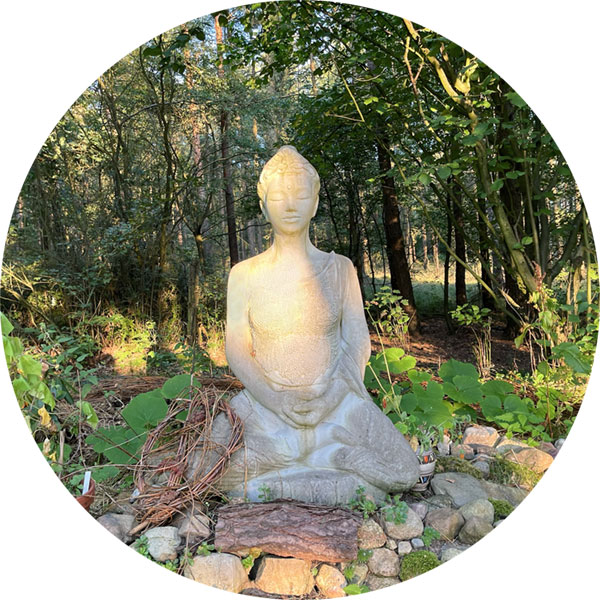
White Stone Tara Statue in the Zen Garden of Togenji Temple, surrounded by forest, mindful and meditative.

This path is not linear. You can begin anywhere – and you’ll notice how the aspects naturally support one another.
In practice, it means: small steps, daily, with heart.

You will receive many different invitations and supports during the retreat to help you rest in stillness. If you begin to feel inner tension and need reflection or support, I am here for you. You can sign up for a one-on-one conversation at any time to clarify questions or uncertainties. There is also the option to communicate with me or the kitchen team through small notes on a shared board.

I warmly encourage you to fully surrender to this natural experience of silence. It is deeply supportive for your retreat if you take care of all important matters beforehand and let people know that you will be unavailable for a few days. This may be a once-in-a-lifetime – or at least very rare – opportunity, and it makes a significant difference to your experience. You are welcome to give my phone number, or that of the retreat center, to your loved ones so we can notify you in case of an emergency.

If, for a truly urgent reason (e.g. accompanying loved ones in birth or dying processes), it is absolutely necessary for you to remain reachable, you may use your phone outside of sight and earshot.

Following the structure together is deeply supportive for all of us – a generous gift we offer one another. Since most of us are used to moving away from uncomfortable sensations and distracting ourselves, it can be very strengthening to experience what happens when we stay. Sometimes simply showing up for a meditation session, even with resistance, allows us to feel how everything – including the resistance – naturally changes.

At the same time, you are warmly invited to find your own way into the practice during the retreat. If you are following an inner thread of spaciousness and stillness while leaning against a tree, you might explore remaining there even when the gong rings for the next session.

“This is the structure — and then see what leads you into freedom.”

Yes. The retreat is ideal for beginners, but also experienced practitioners gain a lot from the lying-down meditation. You can also choose to meditate while sitting or standing.

We practice a noble, friendly silence, more comparable to the silence in a library. Together, we cultivate an attitude of friendliness, compassion, and generosity. No one will tear your head off if a few words slip out now and then. If you feel the need to talk, you can sign up for an appointment on a list or leave me a note on the bulletin board. See also above under: “What if I can’t be quiet?”