Meditation can really be anything but easy sometimes. When we go into the silence and arrive in non-doing, when the body is allowed to simply rest on the earth (yes, we can also meditate while lying down!), then we sometimes really notice how active our mind actually is.
In the Sattipattana Sutta, the discourse on the foundations of mindfulness, Buddha named five hindrances that we encounter on the path of practice. These five so-called hindrances are wanting, rejection, inertia, restlessness (including worries), and doubt.
Obstacles are normal. If I fight against it, I have two problems: the emotion of the so-called “obstacle” and my reaction to it.
There are two messages here. A good and a bad one.
The good news is that the obstacles are not obstacles. They are signposts on our path that connect us with our deepest needs. They show us the way to love and compassion. The bad news is that we often don’t recognize these signposts.
Our inner nature is clear, bright, vast, luminous, joyful, and compassionate. It is love. In our practice, we can become awake to what prevents us from being connected to love, what prevents us from being intimate with life.
When we are angry, it is difficult to impossible to sit on a meditation cushion. The mind weaves the same stories over and over again, one thought leads to the next, and often the anger increases. When anger has taken control, it is as if you have fallen into a wild river and are being swept away by the current. We can no longer think clearly and may act in ways that are painful for ourselves and others.
If we have fallen into a rushing river with a strong current, then it is important that we first get back to shore. Our body can help us with this.
Supportive can be:
Looking around the room, moving your eyes & head
Inviting micro-movements in your fingers
Shaking yourself and noticing yourself doing it (here you can find a guided meditation on this!)
Feeling the earth (floor, blanket, sweater) with your hands
Breathing deeply consciously.
Supportive for dealing with anger is becoming aware of your own goodness and gentleness. Where do you do something good for yourself or others? If you can’t think of anything, then you just haven’t looked long enough. If the mind is used to devaluing others, yourself, or life, then write it down! Write down what was good today! What you like about yourself! What you like about others!
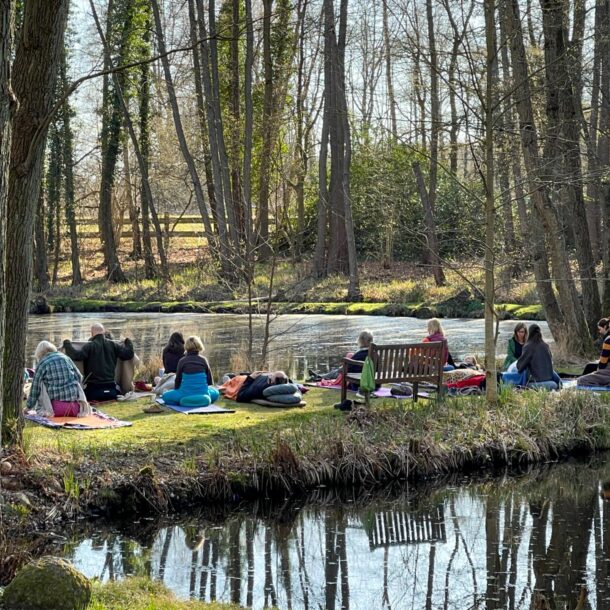
It doesn’t always make sense to sit on a meditation cushion. Sometimes, when the anger is too intense, go into the forest, crawl on the earth, and make animal noises. Lie down on the earth. Stay awake, allow yourself to notice yourself. Maybe you can also find a person who can really listen to you.
Before we can let go of anger, we must first perceive it. Perceive how it separates us from the love within us. We can ask ourselves:
When we are back on the bank, then we have the opportunity to look at the river. For this, it can be very supportive to meditate while standing. From here, we can perceive how anger feels in the body. This sensation can be very physically unpleasant or painful. Sometimes movement can help us to perceive this energy of anger (or rejection, resistance) in the body. Here on the bank, we can also perceive the thoughts that go along with the anger. Can you recognize that they are not fixed and solid? How is it to perceive the space around the thoughts? Or to turn to a part of the body for which thoughts make no sense right now? How does this part of the body feel?
Buddha compared anger to boiling water, through which we cannot see clearly. He said that if we can distance ourselves from anger (rejection, judgments, self-deprecation…), then it is as if we were recovering from an illness.
“What is really happening here?”, “What is it about for me?”, “What do I really need?” This gives us contact with our need that is behind our anger. And what happens when I turn completely to it? This need. To feel the longing for peace, being accepted, relaxation, connection, benevolence, friendship, or whatever it is, deep in the cells. What does the anger cover up? Let yourself be surprised!!